
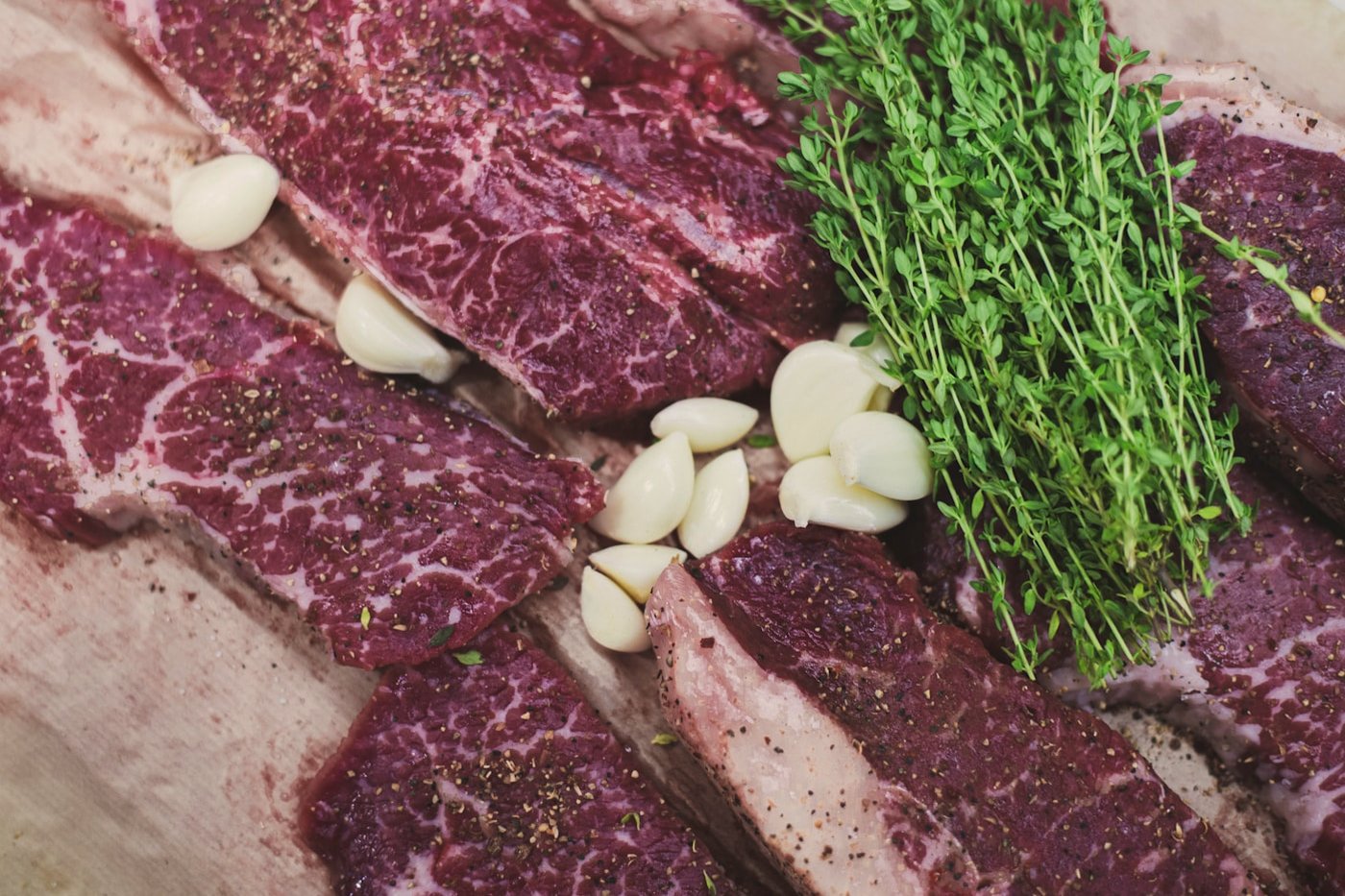
A short rib is one of the few cuts where time is doing more work than fire. The marinade is not the flavour bath people imagine — it is a clock. Run it short and the rib stays chewy through the bone. Run it long and the meat goes pasty before it sees the grill.
The mistake travels well. Walk through any supermarket fridge in Singapore and you will see “Korean BBQ marinade” sold in 500ml bottles, the way teriyaki is sold — as a flavour. It is not. The soy and the sugar and the sesame are decoration. The job is being done by an enzyme.
The cut that sets the clock
LA-style galbi — the flanken cut that has become the default in Korean barbecue restaurants outside Korea — was not invented in Korea. It came out of Korean butchers in Los Angeles between the 1960s and 1980s, working with American rib racks and adapting the cut: the bone is sliced across the grain in three short cylinders, and the meat lies in a flat plane around 1cm thick. The geometry is the whole point. A flanken slice has more cut surface area than any traditional Korean rib preparation, which is exactly what a marinade needs to do its work.
That work has a deadline. Once the meat is sliced this thin, every hour spent in marinade is an hour the cut surface is being chemically reshaped. Eight hours and the proteins start to give. Twenty-four hours and the texture starts to fail.
The enzyme that does the work
The active ingredient in a serious galbi marinade is not soy. It is a protease — a protein-cutting enzyme — most often delivered by grated Korean pear (Pyrus pyrifolia). Food-science work published in the Japanese Society of Animal Science journal isolated a cysteine protease from Korean pear and tested it directly as a meat tenderiser; the same enzyme family appears in pineapple as bromelain and in kiwi as actinidin. Pear is the gentlest of the three, which is why the convention reaches for it. Kiwi will turn a flanken slice to mush by hour six.
The marinade, in other words, is a controlled chemical event. The window matters more than the recipe.
The window, in hours
- Under 4 hours — the surface is seasoned, the interior is not. The rib reads as chewy through the bite.
- 8 to 12 hours — the protease has cut enough collagen to soften without dissolving structure. This is the working range for flanken at 1cm thickness.
- 12 to 24 hours — still safe with pear-only enzyme; risk rises sharply if pineapple or kiwi has been added.
- Past 24 hours — the muscle fibres separate before they hit heat. The meat goes pasty and the bone slides out clean. That is failure, not tenderness.
A galbi marinade is not a flavour. It is a tenderiser, and the timing window is narrow.
What this means at the table
It means a galbi served the same day it was sliced is a different dish from one held overnight, and a kitchen that does not measure that distance is guessing. It also means a galbi packed for takeaway is being marinated to a different schedule than one fired off a passing order — the clock starts when the rib leaves the kitchen, not when the customer opens the box.
Every cut on the grill has a clock. Marbling, covered in a separate piece on what makes a rib worth the grill, decides what the rib can give. The marinade decides whether you get to taste it.
Source: Galbi — Wikipedia, on the LA-flanken origin and the Korean-pear scoring convention. Cross-referenced with cysteine-protease research published by the Japanese Society of Animal Science (J-STAGE).